One number a month, argued once, and everybody downstream has to live with it.
A cycle with four meetings and one output.
A demand number the business agrees on, a supply plan that says what it cannot cover, and a decision about the gap. The cycle fails in the same place every time — the scenarios turn up as slides built after the last meeting, so the argument happens without them.
Demand · supply · reconciliation · executiveUnconstrained, then constrainedScenarios in the room
01 · The decisions at the top
The cycle exists to take four decisions.
Not to produce a pack — to settle these, each with an owner, a meeting and a date.
Superiora holds them as objects in your model, so what was decided last month is still readable this month.
An owner, named
The date it was taken
What it locks underneath
01 · The consensus demand
The number the business agrees it will sell.
Statistical baseline, sales overrides, market intelligence and the promo plan, argued to one figure per family. One number, not a sales number and a finance number that meet at year end.
Taken
At the demand review, monthly, per family
Answers
What we believe we will sell, and where the belief came from
Locks
What supply plans against, the revenue the finance plan carries, the inventory build
02 · The constrained plan
What gets made when capacity will not cover demand.
The interesting decision in the whole cycle, and the one most often left implicit: which customers and products are served first, and what the rest is worth.
Taken
At the supply review and reconciliation
Answers
Who is served, in what order, and what is deferred
Locks
Service level, inventory, the revenue knowingly put at risk
03 · The gap closure
What is done about the distance to the commitment.
The consensus plan rarely meets the number given to the board. The executive meeting decides what closes it — a promotion, a price move, extra capacity — or that the commitment changes.
Taken
At the executive meeting, monthly
Answers
Which lever, how much of it, by when
Locks
Trade spend, capacity calls, the number the board is still being told
04 · The rules of the cycle
Cadence, horizon, grain and who owns each step.
Taken once and revisited rarely, but it decides whether the cycle can be run at all: eighteen months rolling at family level is a different process from six weeks at SKU level.
Taken
At design, reviewed annually
Answers
How often, how far out, at what grain, owned by whom
Locks
What the meetings can argue about, and what the model has to carry
02 · The model they imply
One model, four stages, and a gap you can point at.
Typed out rather than pictured: the drivers that carry a demand number into a capacity problem.
The dimensions the cycle argues over, and the cubes each review reads.
Dimensions the numbers hang on
Cubes they live in
Drivers between them
Model sketch · a monthly S&OP cycledimensions · cubes · drivers
Dimensions
Product › Family the grain of the argument
Customer › Channel hierarchy
Site › Line where it is made
Plan stage baseline, consensus, constrained, financial
Forecast value added = |Actual − Baseline| − |Actual − Consensus| — did the override help?
Constrained plan = MIN(Consensus demand, Capacity available) — allocated by the priority rule
Revenue at risk = (Consensus demand − Constrained plan) × Net price
Gap to commitment = Financial commitment − Constrained plan value
Closed by = Gap actions — each one owned, sized and dated
The switchover — the last closed month, and where the argument starts
Actuals → forecast. The cycle rides the model’s own calendar: the switchover marks the last closed month, the horizon rolls forward one month each cycle, and the stages sit side by side so the distance between the baseline, the consensus and the constrained plan is a figure rather than an impression. Last cycle’s numbers stay where they were — a closed month refuses a rewrite — which is what makes forecast value added measurable at all.
03 · In the product
The pack the meeting runs on, and the model it comes from.
Four screens, all the live product on our demo model — a beverage business, which is not the point.
A pack composed from saved views of a governed model, the starter model an S&OP process can open on, the demand review the cycle is argued over, and the saved action that branches a scenario.
planner.superiora.ai / model / salesLive
A scenario held beside the base · one driver changed inside it · Revenue, COGS and Gross margin re-derive on that row, and the Base row does not move
planner.superiora.ai / spaces / pack boardLive
The cycle pack · the demo model, a beverage business · every card bound to a saved view, so the pack is the model rather than a picture of it — and a scenario can be switched while the meeting is still sitting
planner.superiora.ai / setup / start from
Setup · sales and operations planning is one of the three starter models · it states the calendar, dimensions and cubes it will create before it creates them, and you grow it from there
planner.superiora.ai / spaces / demand review
The demand review · the demo model, a beverage business · the statistical baseline, the planner’s override and the agreed consensus in one grid, with production capacity drawn against the number the meeting is about to commit to
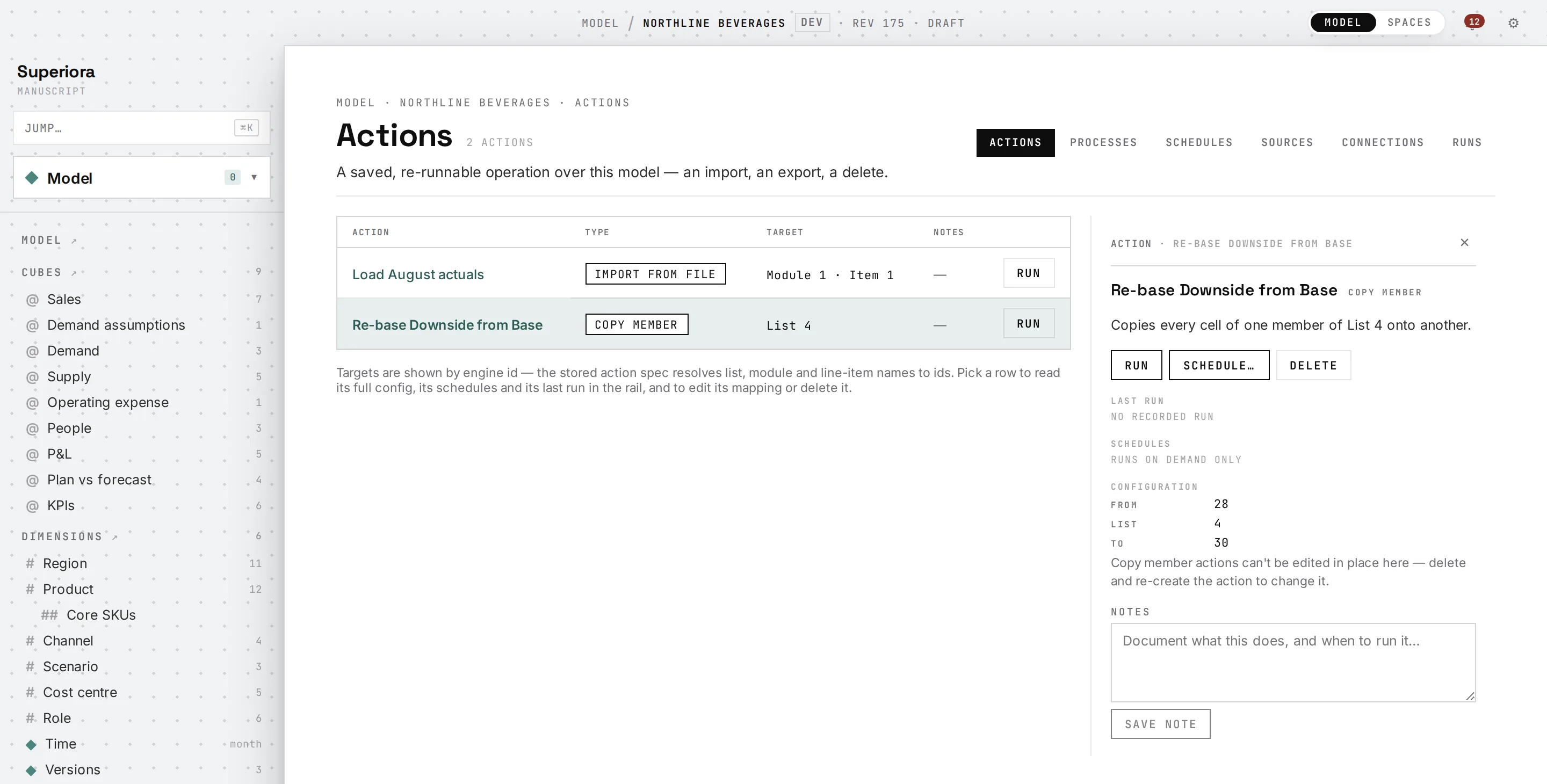
planner.superiora.ai / model / actions
Branching a scenario · a saved copy-member action · a scenario here is a member of a dimension, so branching one is an operation with an owner, a schedule and a run record — not a second workbook
04 · What the agent does here
Delegate the preparation. Keep the call.
The consensus and the allocation rule are not by-products of the pack: we model them first.
Strategy-driven planning, in S&OP: objects with an owner and a date, and the constrained plan, the revenue at risk and the gap derived underneath them.
Build and change the model
Cases and baselines
The routine, on a schedule
Delegated · grounded in the modelthree things given away · one kept
01Build and change the modelAn operator drives Claude over Superiora’s tool set to stand up the stage dimension, the family grain and the capacity grid, and to reshape the cycle when the horizon or the grain changes. The starter S&OP model is where it begins, not where it ends.
02Cases and baselinesEach case in the meeting is a scenario copy of the working numbers with your overrides on top — a lost customer, a line down for three weeks, a promotion pulled forward — each named for the decision it tests. The statistical baseline is fitted on your own history and backtested, so the demand review starts from a number with a track record.
03The cycle’s routineScheduled actions land shipments, orders and capacity on a cron before each review; notifications carry the lock changes and a daily digest so a missing input is noticed before the meeting rather than in it; the pack goes out to PDF and Excel, and every figure in it resolves to a cell.
—Not delegatedThe consensus number, who gets served when there is not enough, and what closes the gap. Superiora brings the cases into the room with the model behind them — the call is made by the people in it.
Bring your decisions. Superiora does the planning.
We stand the decision model up on your own goals, data and KPIs, then build the plans and stress the scenarios underneath them. An hour to see it on your own numbers.